



The challenge is that most podcasters use Instagram the wrong way. They post episode announcements nobody outside their existing followers sees, share audiograms the algorithm suppresses, and measure success by likes rather than by how many people converted from follower to actual subscriber. Growing an Instagram following and growing a podcast audience are two different goals that require two different content strategies.
Why Instagram Works Differently For Podcasters Than For Other Content Creators
Instagram now has 3 billion monthly active users in 2026. The platform is not struggling for attention. The problem for podcasters is that Instagram’s native experience is visual and its algorithm rewards engagement likes, shares, saves, and watch-through rate, while a podcast’s goal is to get people to leave the platform and go listen somewhere else.
That tension is the central challenge of podcast promotion on Instagram. The content that performs best on Instagram is short reels, interactive stories, and swipeable carousels, which is not the same content that converts viewers into listeners. Understanding which formats serve which goal determines whether Instagram becomes a genuine growth channel or a time-consuming activity that produces engagement but no actual listeners.
Instagram Serves Two Distinct Purposes For A Podcast:
- Discovery: Reaching people who have never heard of the show through the Instagram Reels algorithm, the Explore page, and hashtag search. This requires content optimized for non-followers, which means the content needs to work for someone who has no context about the show, the host, or the topic.
- Conversion: Convincing existing followers to actually listen to the podcast. This requires content that builds enough trust, curiosity, or urgency to make someone open a different app entirely. Most podcast Instagram accounts optimize heavily for discovery and almost not at all for conversion, which is why follower counts often grow faster than download numbers.
Setting Up The Instagram Profile For Podcast Growth
Before any content strategy makes sense, the profile needs to do its job. The Instagram profile is the first thing a potential new listener sees after clicking through from a reel or a story mention, and it has roughly three seconds to answer three questions: what is this show about, who is it for, and how do I find it?
The bio:
Write the bio for the listener. A bio that opens with the host’s credentials serves the host, but the one that opens with the specific outcome or perspective the podcast/show offers serves the listener. So, lead with the show’s topic and the audience it serves, and include the posting schedule so newer followers know what to expect.
The link:
Linktree solves a real problem – it gives a profile and one URL that connects to multiple. But for podcast conversion, every extra click between someone seeing the link and hearing the episode reduces the chance they follow through. The link should go directly to the most recent episode or to a landing page with a single call to action. Give the visitor one decision to make.
The highlights:
Use Instagram Story Highlights to give new profile visitors a quick orientation to the show. One highlight for recent episodes, one for guest highlights, and one for listener testimonials covers the three most common questions a first-time visitor has. Keep each highlight under ten stories.
The Content Formats That Work For Podcasters And When To Use Each
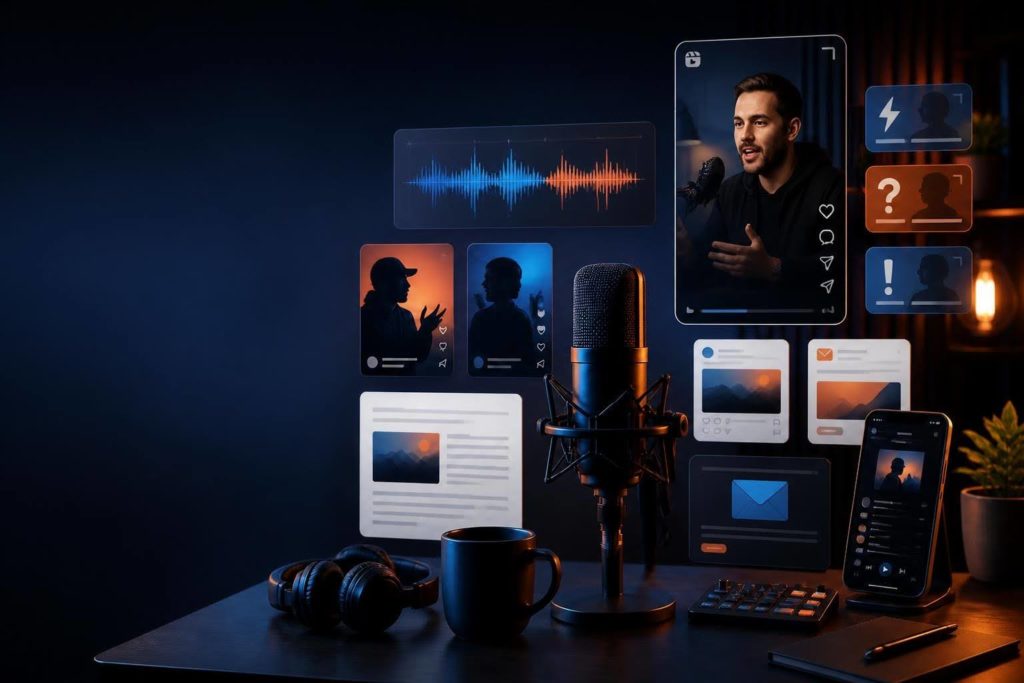
Reels account for 50% of all time spent on Instagram in 2026, and 55% of reel views come from non-followers, making it the only format on Instagram that consistently reaches people who have never heard of the show. Carousels lead in engagement rate among existing followers. Stories drive conversions from people who already follow the show.
Each format serves a different goal and should be treated differently:
Reels: The Discovery Format
A reel for a podcast serves one purpose: stopping a non-follower mid-scroll and giving them a reason to care about the show. It is not an advertisement for the episode. It is a standalone piece of content that happens to come from the show.
The Hook Formula For Podcast Reels:
The first three seconds determine whether the reel gets watched.
For podcast content specifically, three types of hooks consistently stop the scroll:
These three hook structures appear repeatedly in high-performing B2B content because each one opens with an unresolved tension in the first two seconds. The provocative claim triggers disagreement the viewer wants to settle. The specific question drops them into a scenario they recognize from their own work. The surprising reversal contradicts an expectation they already hold. In each case, the viewer has to keep watching to resolve what the opening created, and that decision to keep watching is what the algorithm registers as a signal worth rewarding.
The provocative claim: “Most B2B marketers are measuring the wrong thing and their bosses have no idea.” It works because it creates an immediate tension the viewer wants resolved.
The specific question: “What do you do when your biggest customer asks for a price reduction you cannot afford to give?” It works because it drops the viewer into a specific scenario they recognize.
The surprising reversal: “We built a podcast that generated zero downloads in the first three months and $400,000 in pipeline by month six.” It works because it contradicts what the viewer expects.
What does not work for podcast reels is a generic clip of two people talking. Without context, a conversation clip gives a non-follower no reason to keep watching. The clip needs to surface the most surprising, specific, or useful moment from the episode in the first three seconds, not build toward it.
What The Algorithm Rewards In Reels:
Reels with a jump cut every three to five seconds average 32% higher engagement than single-shot videos. Adding trending audio increases engagement by 42%.
Captions are not optional: most Instagram videos play without sound, and a reel without captions loses most of its potential reach immediately.
The Three Signals That Determine Whether A Reel Reaches New Audiences:
- Save rate measures whether the content was useful enough to keep.
- Share rate measures whether the content was relevant enough to send to someone else.
- Watch-through rate measures whether the hook was strong enough to keep people watching to the end.
These three signals carry more weight in the algorithm than likes or comments. A reel with 200 saves and 150 shares will outperform a reel with 2,000 likes and 10 saves in terms of new audience reach every time.
Carousels: The Value And Retention Format
Carousels lead all Instagram formats in engagement rate at 0.50% in Q2 2026, making them the strongest format for building deeper connections with existing followers. A carousel that summarizes the five most useful insights from an episode, presents a framework the guest shared, or breaks down a counter-intuitive finding from the conversation gives followers a reason to save the post and return to it.
The Carousel Format That Works For Podcast Content:
- Slide 1: a single strong claim or insight from the episode as a hook
- Slides 2 to 5: the supporting evidence, context, or steps that expand on the claim with enough depth to be useful on its own
- Final slide: the call to action that directs to the full episode
Keep the text on each slide to under 30 words. A carousel that requires reading paragraphs per slide loses most viewers before the third slide.
Stories: The Conversion Format
Stories reach existing followers, not new audiences. That makes stories the primary conversion tool for turning followers into actual listeners. A story sequence published on episode launch day, where the host shares a personal note about why this episode matters to this specific audience, a poll asking whether followers face the problem the episode addresses, and a link to the episode on Spotify and Apple Podcasts, converts followers to listeners more reliably than any other Instagram format.
The poll step is important. A follower who votes in a poll has actively engaged with the content. Interactive poll stickers increase overall story interaction by 30%, and that micro-commitment makes the next step, clicking the episode link, significantly more likely than for a follower who passively views a story without responding.
The Conversion Path from Instagram to Podcast Listener
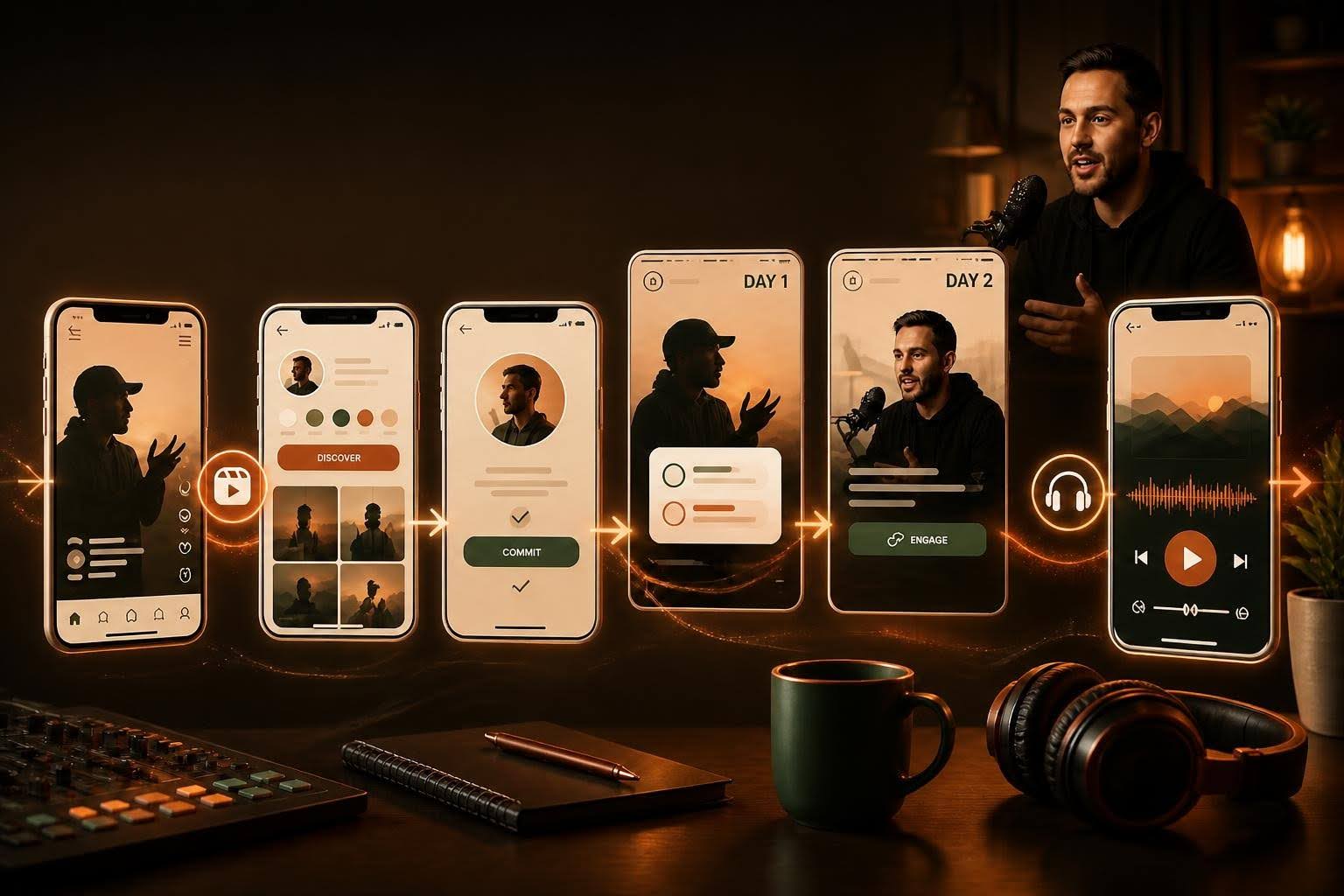
The most overlooked part of podcast Instagram strategy is the conversion path. Most podcast accounts treat the link in bio as the end of the strategy. It is not. It is the beginning of the hardest part: getting someone who just discovered the show on Instagram to actually open a different app and start listening.
The Conversion Sequence That Works:
Step 1: The hook content (reel or carousel) stops the scroll and creates curiosity about the show’s topic. It does not ask the viewer to do anything yet.
Step 2: The profile visit happens when the hook content is good enough that the viewer clicks through to the profile. The profile needs to immediately confirm that the show covers the topic the reel addressed and give the visitor one clear next step.
Step 3: The follow is an intermediate conversion. A follow indicates intent but not commitment. Most followers never become listeners unless the account gives them a specific reason to make the jump from Instagram to a podcast app.
Step 4: The conversion trigger is the piece of content that finally moves a follower to press play. For most podcast accounts, this is a story sequence published on episode launch day with a direct link and a personal note from the host explaining why this specific episode is worth 40 minutes of the follower’s time.
The most important thing a podcast Instagram account can do to improve conversion rate is treat every episode launch as a two-day story campaign: day one is the personal note from the host and a poll, day two is a reply to the poll with the result and the episode link framed as the answer to the question the poll raised.
The Guest Amplification System On Instagram
Accounts with guests who have existing audiences can see download increases of 20 to 300% per episode, but most podcast teams leave this opportunity unused because the guest shares once in a story and moves on.
Building A Guest Amplification Kit For Instagram:
Send every guest two days before the episode publishes:
- A pre-written caption in their voice with the episode link and the show’s handle tagged
- Three reel clips from their strongest moments in the episode, formatted for Instagram vertical video with captions
- A quote graphic with their name, the show’s branding, and their most quotable line from the conversation
- A Story sequence: one slide with the episode announcement, one slide with a specific question they addressed in the episode, and one slide with the link
A guest who receives a kit requires no extra effort to share meaningfully. Remove every friction point between the guest and a share that reaches their audience, and the episode’s Instagram reach expands to include an audience the show team could not have accessed through any paid or organic means.
The Caption Strategy Most Podcasters Get Wrong
Most Instagram guides for podcasters stop at telling you to write a caption. What the caption actually needs to say for podcast content is a different question entirely.
A weak podcast caption reads: “New episode out now! I sat down with Jane Smith to talk about demand generation. Link in bio.”
A strong podcast caption reads: “Jane Smith ran demand gen at three different B2B companies and failed at the same thing every time. She fixed it at company three and doubled pipeline in six months. In this episode she explains exactly what she changed and why the first two attempts did not work. The episode link is in the bio, and it is worth the 40 minutes.”
The difference is specificity and stakes. The weak caption describes what the episode is. The strong caption describes what happened and why it matters to the specific person reading.
Caption Length For Podcast Content:
Longer captions perform better for podcast promotion than for product promotion because the caption is doing the job of a trailer, as it provides a lot of information to the viewer. The caption needs to give the reader enough context to decide whether the episode is worth 40 minutes of their time. Under 150 words is usually not enough to make that case. Between 150 and 300 words, if the writing is specific and does not repeat itself, is the range where podcast captions tend to produce the most clicks through to the episode.
Instagram for Branded and B2B Podcast Teams
For a branded or B2B podcast team, Instagram serves a different function from what it serves for an independent creator show. The content strategy needs to account for the fact that the immediate viewer of a reel and the eventual podcast listener may be different people at different stages of the buying process.
For B2B Branded Podcasts, Instagram Serves Three Specific Jobs:
- Top-of-funnel brand awareness for potential customers who do not yet know the company exists. A reel from a branded podcast episode that surfaces a genuinely useful insight about a problem the target customer faces builds brand recognition without requiring the viewer to know anything about the company.
- Thought leadership positioning for the internal expert or executive who hosts the show. Personal brand content from the host on their own Instagram account, referencing specific episodes, builds credibility in the market that the company account alone cannot achieve.
- Community building with existing customers and prospects who already follow the brand. Story content, polls, and direct questions to followers deepen the relationship between the brand and the people already in its orbit.
For a B2B branded podcast team, AirShots handles the short-form clip creation from recorded sessions that feeds the Instagram Reel strategy. The clips produced from a session in AirStudio go directly into the Instagram distribution workflow without requiring a separate video editing step. Confirm current plan availability with the Airmeet team before building a clip production workflow around either product.
What to Measure on Instagram as a Podcaster
Most podcast teams measure Instagram the wrong way. Follower count and likes are the metrics that feel meaningful and the ones that matter least for podcast growth. The metrics worth tracking are:
- Save rate per post: saves indicate that the content was useful enough to keep. A save rate above 2% on a reel or carousel indicates content that is genuinely serving the audience rather than entertaining them briefly.
- Share rate per post: shares indicate that the content was relevant enough for a follower to send to someone else. Shares drive word-of-mouth growth that no algorithm can replicate.
- Story link clicks on episode launch days: this is the most direct measure of Instagram’s conversion rate into actual listeners. Track how many story link clicks each episode launch sequence generates and compare across episodes to identify which topics, hooks, and caption approaches convert followers to listeners most effectively.
- New follower source after a Reel: when a reel performs significantly better than average in reach, check whether the new followers it generated came from the target demographic. Reach from the wrong audience produces follower growth that does not convert to listeners regardless of how well the conversion content performs.
Conclusion
Instagram is one of the most effective podcast discovery channels available in 2026 for shows targeting a younger or content-driven audience and one of the most misused. The teams that get genuine listener growth from Instagram are the ones that separate discovery content from conversion content, treat the guest amplification kit as a standard part of every episode launch, write captions that describe specific stakes rather than announcing an episode exists, and track saves, shares, and story link clicks rather than follower count and likes.
The goal is to find the right person at the right moment with the right 30 seconds of content that makes them want to spend 40 minutes with the show. Instagram at its best is a precision discovery tool for that specific job.
FAQs
Three to four posts per week is a realistic starting point: one reel from the latest episode, one carousel with key insights, and two stories on episode launch day. Accounts posting at least four reels per week see 23% higher engagement, but quality matters more than frequency.
Stories with a direct episode link convert existing followers to listeners most reliably, while reels reach new audiences who become those followers. Use both in sequence: Reels bring new followers in, and Stories convert them on publish day.
Most Instagram metrics do not connect directly to business outcomes for a branded podcast. The three metrics worth reporting are:
- Story link clicks on episode launch days: the most direct measure of Instagram converting followers to listeners
- Profile visits from Reels: indicates whether discovery content is generating genuine interest in the show rather than just views
- Saves and shares per post: the algorithm signals that determine whether content reaches new audiences, which is the primary business value of Instagram for a branded show