




That is especially important in financial services, where a webinar can involve customer information, financial discussions, investor communications, internal business details, and records that may need to be retained. There is very little room for an access mistake, an accidental disclosure, or sensitive information ending up where it shouldn’t.
And security does not start when the webinar goes live. It starts much earlier, with how you collect attendee information, who you allow into the event, what permissions you give speakers and moderators, and how you plan to handle the data and recording afterward.
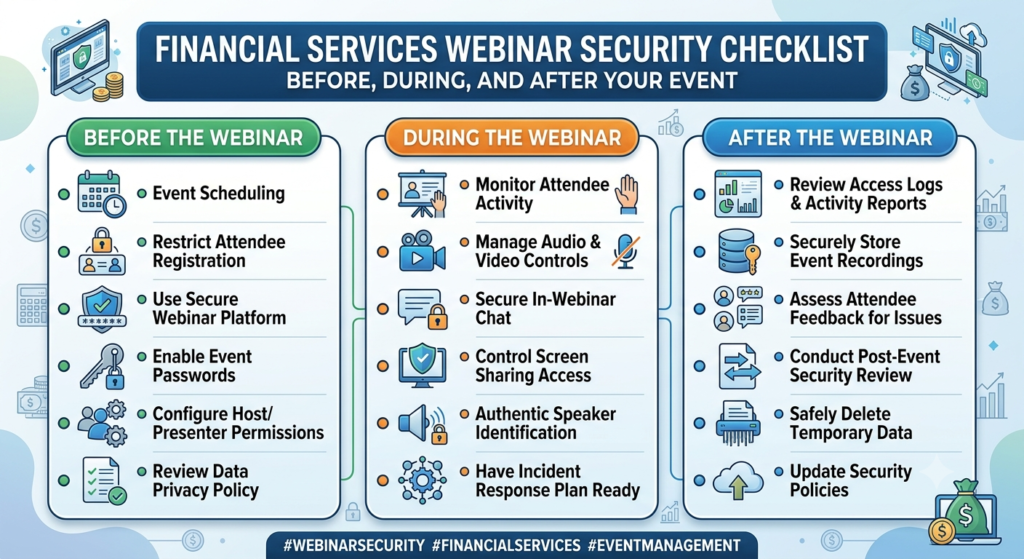
This financial services webinar security checklist walks you through the key steps to consider before, during, and after your event, helping you protect sensitive information, control access, and keep security as part of the process from beginning to end.
1. What’s Unique about Webinar Security for Financial Services?
The most significant difference is the information involved.
A general business webinar might involve a product presentation or industry discussion. A financial services webinar can involve much more sensitive material, including customer information, investment discussions, internal business information, and regulated communications.
For organizations covered by the GLBA Safeguards Rule, protecting customer information is already part of their broader information security responsibilities. The FTC says that covered financial institutions must maintain safeguards designed to protect customer information and must also take steps to ensure that relevant service providers safeguard the information they hold. That makes the webinar platform, registration process, access controls, speakers, moderators, and recordings part of a much bigger security picture.
2. Build Your Webinar Around the Audience
If you have held a financial services webinar, you already know that the audience can vary from one event to another. A public webinar on financial education is not the same as a private investor briefing or a client-only discussion. Depending on who will be attending and what you plan to share, different levels of security may be appropriate.
Before creating the event, know who the webinar is for, what you will discuss, and what information you will collect. Basic registration may be sufficient for public events, but if the event is limited to employees, clients or certain stakeholders, other controls may be required. General financial information is less at risk than confidential business or financial information.
These factors will help you decide how much authentication you need. This can range from simple registration to robust Single Sign-On (SSO), Multi-Factor Authentication (MFA), registration approval, or attendee verification. You want security to match risk but not so complicated that it’s an unnecessary barrier to entry for people who want to get involved. This is an important step in following financial webinar attendee authentication best practices.
3. Keep Registration Useful Without Collecting Too Much
Registration is often the first place where attendee data enters your webinar environment.
It is tempting to ask for more information because the data could potentially be useful for sales, marketing, or reporting later. But collecting information simply because you can create another responsibility for your organization.
A webinar data privacy checklist for financial institutions should therefore include data minimization.
Before publishing the registration page, ask:
- Do we need every field on this form?
- Why are we collecting each piece of information?
- Who will have access to it?
- Will it be transferred to another system?
- How long will we keep it?
- Have attendees been given appropriate privacy information?
This becomes important when a webinar involves information that could fall within the organization’s obligations around nonpublic personal information (NPI).
The less unnecessary information you collect, the less information you have to protect.
To get an insight into protecting the attendee data and managing webinar privacy, you can check out How to Make Your Webinar GDPR-Compliant, which covers practical considerations such as data minimization, registration information, recordings, Q&A, and third-party providers.
4. Choosing a Secure Webinar Platform
The webinar platform is part of your security architecture.
That means a vendor comparison should go beyond pricing, audience limits, engagement features, and analytics.
A proper vendor security assessment for webinar platforms should look at how the provider handles security throughout the event lifecycle.
Among the areas worth reviewing are
- Encryption in transit and at rest.
- SSO, multi-factor authentication.
- Role-based access control.
- Administrative Rights.
- Security testing.
- Audit logs and visibility into activity.
- Data retention and erasure policy.
- Process for handling incidents.
- Security certifications and independent assessments.
- Controls around third-party service providers.
For financial organizations, the platform also needs to fit the way they actually manage events. Compliance teams may need visibility before the event goes live, marketing teams may run registration and communications, and moderators and speakers manage the live session.
A platform that brings these workflows together can make it easier to assign responsibilities, control who can access what, and keep a clear record of the event. That matters when webinars involve multiple stakeholders and the margin for an avoidable mistake is small.
5. Managing Access Across the Event
A secure webinar does not mean giving every participant the same permissions.
The person hosting the event may need administrative controls. A moderator needs to manage questions and chat. A speaker needs presentation access. An attendee may need to simply watch and participate. Role-based access gives the right access to the right people based on their roles.
Before the event, review who has access to
- Event administration.
- Speaker controls.
- Screen sharing.
- Chat and Q&A moderation.
- Recordings.
- Attendee information.
- Post-event analytics.
The chances of accidental exposure can be reduced by removing unnecessary access. For events that are sensitive, organizations can also use controls such as SSO, MFA, approved domains, registration approval and individualized access controls to help prevent unauthorized entry.
6. Speaker Best Practices for Secure Webinars
Technology can be secure, and the event can still go wrong.
Consider what happens when a speaker shares their entire screen and an internal email, spreadsheet, customer record, or confidential document happens to be open in the background.
It only takes a few seconds for someone to expose information.
A short speaker briefing before the webinar can prevent many of these situations.
Speakers should know:
- What they are allowed to share.
- Whether the session is being recorded.
- How screen sharing is configured.
- What information should never appear on screen.
- How to handle questions involving confidential information.
- If something goes wrong, who should the team contact
For demonstrations, using sample or anonymized information is preferable to displaying real customer information whenever possible.
7. Managing Q&A Securely During Financial Webinars
Audience questions are one of the best parts of a webinar. They also introduce something the speaker cannot completely control: information coming from the audience.
An attendee might unintentionally include a client name, account detail, phone number, or another sensitive piece of information in a question.
That is why knowing how to moderate Q&A in a finance webinar securely matters.
Anything inappropriate or sensitive should be removed by the moderator before it is visible to the audience.
A good moderation process should cover:
- Whether questions are reviewed before publication.
- Who has the authority to remove a question.
- How sensitive information is handled.
- When an issue needs to be escalated to legal, compliance, privacy, or security teams.
- The same thinking applies to chat. If attendees can post messages during the session, someone should monitor what they share.
8. Think About Compliance Before the Webinar Goes Live
A responsible financial webinar is about more than security.
The content itself may be subject to communication, supervision, or recordkeeping requirements depending on the organization and the nature of the event.
For FINRA member firms, Rule 2210 establishes standards for communications with the public and includes requirements relating to review, supervision, and recordkeeping. FINRA also points applicable firms to the retention requirements under SEA Rule 17a-4 for certain communications.
FINRA’s Books and Records Requirements Checklist can help compliance and event teams work from the same plan.
Before the webinar, determine:
- Whether the communication requires review or approval.
- Which materials need to be retained.
- Who is responsible for maintaining those records?
- Whether the webinar generates additional records such as chat or Q&A.
- What retention and preservation requirements apply.
The important point is not to assume that every webinar has identical regulatory requirements. The event, audience, communication type, and organization all matter.
9. Preparing for Security Incidents During Your Webinar
Even a well-managed webinar can have an unexpected problem.
An access link could be forwarded. A participant could share sensitive information. A recording could be given the wrong permissions. A speaker could accidentally expose confidential material.
The response should not begin with people asking, “What do we do now?”
Instead, an event runbook can establish the process in advance.
It can identify:
- Who monitors the event?
- Who can remove an attendee?
- Who controls recording and sharing settings?
- Who should be contacted about a security incident?
- When should legal, compliance, privacy, or security teams become involved?
- Which records should be preserved?
This is very important for a secure webinar checklist for banks and credit unions, as different teams will have to coordinate quickly if customer information is involved.
10. Managing Your Webinar Data After the Event
Once the final attendee signs off, the event has created a collection of information that may still need attention.
There could be
- A recording.
- Attendance information.
- Registration data.
- Chat messages.
- Q&A.
- Poll responses.
- Engagement analytics.
- Presentation materials.
All these need to be handled according to the organization’s privacy, security, records management, compliance policies, etc.
Recordings deserve particular attention because they can contain everything that happened during the session.
11. Understand Your Recording Retention Responsibilities
One of the most common mistakes is assuming there is a single standard answer to the question, “How long should we keep this webinar?”
Financial webinar recording retention requirements can depend on:
- The type of organization
- The type of communication
- Applicable regulations
- The firm’s recordkeeping policies
- Whether FINRA rules require the records to be kept for a specific period
For broker-dealers, SEC Rule 17a-4 sets requirements for electronic recordkeeping. Its current framework allows an audit-trail alternative to the traditional WORM approach, subject to the rule’s requirements.
That means financial teams should determine the appropriate retention and preservation approach with their compliance, legal, and records-management teams rather than applying a generic webinar policy.
Before deleting a recording, ask:
- Is it a record that must be preserved?
- Has the applicable retention period ended?
- Is there a legal hold?
- Who is authorized to approve deletion?
- Are copies stored somewhere else?
12. Keep Financial Webinars Resilient
A secure webinar also needs to remain usable when something does not go according to plan. A platform outage, connectivity issue, unavailable speaker, or unexpected security incident can disrupt an important client or investor event. Financial teams should have a basic business continuity plan for critical webinars.
This could include:
- A backup presenter or moderator.
- Another way to communicate with registered attendees.
- A clear escalation process for technical or security issues.
- Backup copies of essential presentation materials.
- Defined criteria for postponing or ending an event.
For high-stakes financial events, continuity is part of security. The goal is not only to protect the webinar from unwanted access or data exposure but also to make sure the organization can respond calmly when the unexpected happens.
A Better Way to Think About Secure Financial Webinars
Webinar security will depend on the type of event you are running. Financial firms should use controls that fit their audience, content, and the information they share.
- A public educational session may need a simple registration process and basic access control.
- A private client webinar will need stronger authentication, restricted access, moderated Q&A, tighter permissions, and more careful handling of recordings.
That is why financial teams should think about security across the entire event:
Plan the audience. Protect the data. Control access. Prepare the speakers. Moderate the conversation. Preserve the right records.
This approach makes it easier to host a compliant financial services webinar without turning every event into a complicated technical exercise.
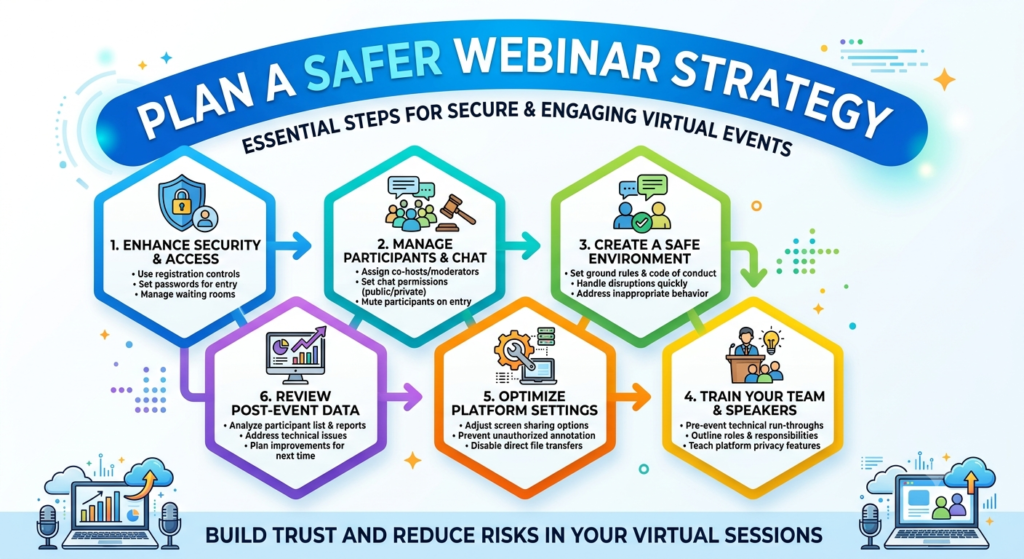
Plan a Safer Webinar Strategy
Security should not feel like something added to a webinar at the last minute. With Airmeet, financial teams can bring access controls, attendee management, engagement, and event security into the same workflow, whether they are hosting investor sessions, client education programs, regulatory training, or market updates.
Features like SSO, MFA, role-based permissions, audit trails, and secure event management can help teams keep control over who joins, what they can do, and what happens to event data afterward. For teams comparing platforms, Airmeet’s guide to selecting a secure webinar platform for enterprises can help teams review security before choosing a platform.
Final Thoughts
A financial webinar may last an hour, but the information surrounding it can have a much longer life.
That is why security should be considered from the first registration field to the final recording review.
When financial teams know who should have access, collect only the information they need, prepare speakers and moderators, understand their recordkeeping responsibilities, and have a response plan ready, webinars become easier to manage and safer to scale.
Taking a financial webinar online should not make things harder. Security, privacy, and trust still need to be looked after while keeping the event simple to manage.
FAQs
They can be, provided the right controls are in place for access, authentication, data protection, permissions, and recording.
Look for SSO, MFA, role-based access, encryption, recording controls, audit logs, and strong administrative permissions.
It depends on the organization, audience, content, and applicable regulations. Some communications may require review or approval before the webinar.
Collect only necessary information, restrict access to attendee data, use appropriate authentication, and define how the information will be stored and retained.