




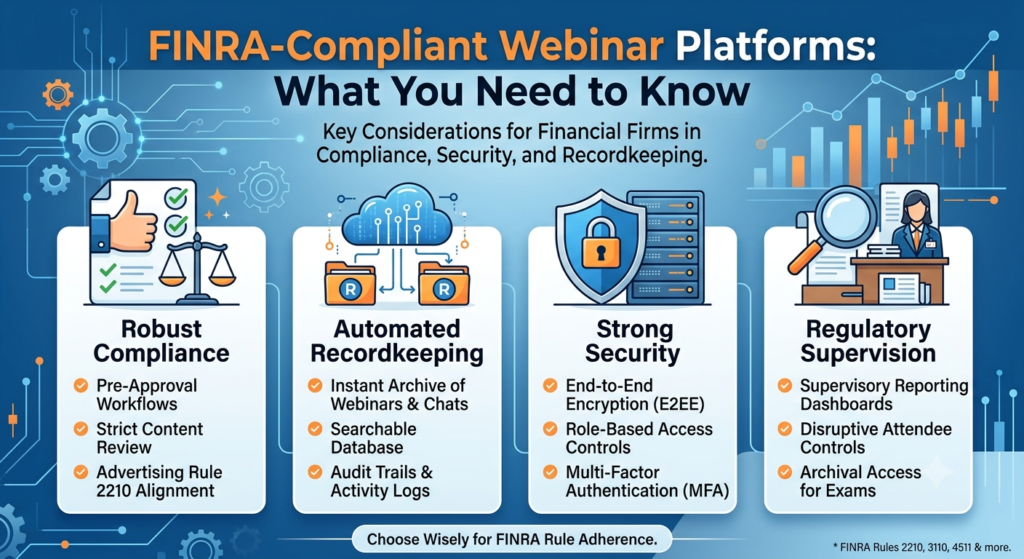
A financial firm webinar is more than just getting speakers and attendees to the event. Registration details, conversations, recordings and other information about the event will need to be carefully managed. A FINRA-compliant webinar platform can give finance teams the controls they need to manage access, protect information, and support their compliance processes. But choosing the right platform takes more than looking at a list of features. Let’s look at what financial firms should check before they choose one.
What Does “FINRA-Compliant Webinar Platform” Actually Mean?
There is no official FINRA certification for webinar platforms. When financial firms use the term “FINRA-compliant webinar platform,” they are generally referring to a platform with features that can support their compliance processes, such as access controls, moderation, security, and recordkeeping.
The platform itself does not make a webinar compliant. The financial firm is still responsible for managing the event, reviewing its content, controlling access and keeping the required records.
A webinar can also create a lot of information, like registration details, presentation slides, speaker notes, chat messages, Q&A responses, poll results, attendance records, recordings, transcripts, and follow-up communications. Firms need to know how this information is stored and retained because FINRA rules require them to keep certain communications and records. Details can be found in FINRA Rule 2210.
When choosing a platform, firms therefore need to look beyond the live event. They should also consider how they will manage the information created before, during, and after the webinar.
Start With the Type of Webinar You Are Running
Not every financial webinar has the same purpose or audience. An internal training session is different from a public investor education webinar. A product-focused event for retail investors may also need a different review process from an event intended only for institutional investors.
The type of webinar you are running can also affect the compliance process. FINRA Rule 2210 distinguishes between correspondence, retail communications, and institutional communications, with different requirements applying depending on the type of communication. It also requires communications to be fair, balanced, and not misleading.
That means the firm should decide how the event will be classified before it starts planning the content and access controls. The platform should then fit into that process.
The audience is another factor to consider. A webinar designed for existing clients may have different content and interaction requirements from one aimed at prospects or a wider public audience. Understanding Audience Needs in Finance Industry Webinars look at how financial firms can plan webinar content around different audiences and use interactive elements such as Q&A and polls.
For example, if an event falls under a communication category that requires review or approval, the firm should have a process for getting the presentation and other relevant material reviewed before the event. The platform can support that process, but it cannot replace it.
Look Beyond Basic Login Security
A password alone is not much of a security strategy for a financial webinar.
Start with authentication. Hosts, speakers, moderators, and administrators should have appropriate controls such as SSO and MFA. For external attendees, registration controls and unique access links can help reduce the chance of unauthorized people joining. It is also worth looking at what happens after someone gets access.
A platform should let the firm control what different users can do. An attendee should not have the same permissions as a presenter. A moderator may need access to Q&A and chat controls without being able to change the entire event.
These permissions become especially important when several people are involved in running an event. Giving access to everyone will create unnecessary risk.
Security should be considered alongside other platform requirements rather than as a last-minute check. The Definitive Guide to Selecting a Secure Webinar Platform for Enterprises covers areas such as authentication, role-based access, audit logging, data protection, integrations, and incident response that enterprise teams can consider when evaluating a webinar platform.
Managing Access Across Your Webinar Team
Role-based access is useful for more than keeping unauthorized attendees out.
Before an event, decide who needs to manage registrations, who will present, who will moderate questions, who can access recordings, and who needs administrative control over the event.
Then give each person only the permissions required for their role.
This also makes it easier to review access later. If there is a question about who could change an event setting, access a recording, or manage attendee information, the firm should be able to answer it without having to piece together information from several systems.
The same approach should be considered when a webinar platform or another third-party provider has access to the firm’s information. FINRA’s guidance on third-party vendors highlights areas such as vendor due diligence, information security, access management, business continuity, and oversight of outsourced activities. FINRA Regulatory Notice 21-29 provides more detail on these areas.
Managing Content During the Live Webinar
Content approval should not stop once the presentation deck has been approved.
Speakers can go beyond the prepared slides. Attendees can ask unexpected questions. A moderator may need to decide whether a question should be answered publicly. Someone could also post information in the chat that was never part of the approved presentation.
FINRA Rule 3110 requires member firms to maintain a supervisory system reasonably designed to achieve compliance with applicable securities laws and regulations and FINRA rules. It also requires written supervisory procedures, with final responsibility for proper supervision resting with the member.
For webinars, firms should have a clear process for managing live interactions as well as prepared content.
The people running the event should know who is responsible for moderating Q&A, what types of questions should be escalated, and what happens if a speaker says something that needs follow-up.
This is particularly important when the webinar involves investment products, market commentary, performance information, or other regulated communications. The team should know what has already been approved and when a live response needs to be reviewed before it is shared.
Keep Q&A and Chat Under Control
Chat and Q&A can make a webinar more useful, but they can also create additional communications for the firm to manage.
A platform should give moderators enough control to decide who can post, whether questions are visible to everyone, and whether content can be removed when necessary.
It also helps to decide these settings before the event. Leaving moderation decisions until the webinar is already underway puts unnecessary pressure on the event team.
In larger or sensitive events, have someone monitor the Q&A and chat, and not have the presenter do it.
Interactive features can be valuable in financial webinars because they give attendees a way to ask questions and participate in the discussion.
Interactive features can be valuable in financial webinars because they give attendees a way to ask questions and participate in the discussion. Airmeet’s How Top Finance Leaders Build Trust & Dominate Their Market Through Webinars examines how finance organizations use live Q&A, polls and interactions to engage their audiences.
The firm should also decide what happens to these interactions after the event. If chat messages, questions, or other communications need to be retained under the firm’s policies or applicable requirements, the platform should make it possible to capture and manage them appropriately.
Know What Happens to Webinar Data
The webinar does not end when everyone leaves the virtual room. Registration information, attendance data, recordings, transcripts, chat messages, Q&A, analytics, and information shared through integrations can all remain in the platform or move into other systems.
That makes data minimization worth considering from the beginning. If the firm does not need a particular piece of information to run the event or meet a legitimate business requirement, there may be little reason to collect it.
Integrations need the same attention. A webinar platform may connect with a CRM, marketing system, analytics tool, learning system, or AI feature. Before enabling any of these, the firm should understand what information is being shared and where it goes.
AI features deserve particular attention when webinars involve sensitive or regulated communications. Firms should check whether the feature processes event content, what information it uses, where it is stored, and whether it can train or improve another service.
The goal is not to avoid every integration. The goal is to know what each connection does before it is given access to event information.
Ask the Vendor the Right Security Questions
A vendor’s security page can tell you a lot, but it should not be the end of the review.
Finance teams should ask specific vendor security questions for webinar platforms before committing to a service.
Ask how authentication works, how administrator access is controlled, whether audit logs are available, how recordings are protected, where data is stored, how incidents are handled, and what happens when data needs to be exported or deleted.
It is also worth asking about third-party providers. If the vendor relies on another company for hosting, storage, analytics, transcription, AI, or another part of the service, the firm should understand what role that provider plays and what information it can access.
FINRA has specifically addressed vendor oversight in Regulatory Notice 21-29. The notice discusses areas including vendor due diligence, information security, access management, business continuity, books and records, and oversight of changes to vendor systems. It also makes clear that outsourcing does not remove a member firm’s supervisory responsibilities.
The contract matters too. Firms should know what happens to their data if the service is terminated, how quickly records can be retrieved, and what support the vendor provides during an incident or regulatory request.
Testing the Platform Before Your Webinar
A platform can look perfectly fine during a demonstration and still cause problems during a real webinar.
Run a test event before using it for important financial communication.
Try joining as different types of users. Check what an attendee can see and do. Test presenter and moderator permissions. Try the registration process. Test Q&A and chat moderation.
If the event is recorded, check what gets captured and where the recording goes. If transcripts are available, check how they are stored and whether they can be exported.
Integrations should be tested as well. A CRM or marketing connection may transfer more information than the event team expects.
It is also worth testing the less obvious situations. What happens if the main host loses their connection? Can another authorized person take control? Can a moderator remove an attendee quickly? Who should the team contact if the platform stops working?
Testing these situations before the event gives the team a chance to resolve problems while there is still time.
Plan for Recording and Retention
Recording a webinar can be useful, but that does not mean every webinar needs to be recorded.
Before recording, the firm should know why it is needed, what it will contain, who will access it, and how long it should be kept.
The same thinking should apply to transcripts, chat messages, Q&A records, and other information created during the event.
For broker-dealers, FINRA Rule 4511 requires firms to make and preserve books and records as required by FINRA rules, the Exchange Act, and applicable Exchange Act rules. It also provides a six-year default retention period for FINRA books and records where no other period is specified. That does not mean every webinar recording automatically has to be kept for six years.
The SEC’s electronic recordkeeping requirements also matter when a webinar creates records that fall within the firm’s regulatory recordkeeping obligations. For broker-dealers, the SEC permits either a WORM approach or an audit-trail alternative that allows the original record to be recreated if it is modified or deleted.
This makes a financial webinar recording and retention policy more useful than a blanket rule to record and save everything.
The policy should explain what needs to be recorded, where records are stored, who can access them, how long they are retained, and what happens when a legal hold applies.
It should also address how records can be retrieved when needed. A platform that stores recordings but makes them difficult to export or produce later may create another problem for the firm.
Preparing for Webinar Incidents and Disruptions
Not every webinar problem is going to be a security breach.
A presenter might accidentally share the wrong screen. An attendee could gain access using someone else’s link. Sensitive information could appear in the chat. A recording might be shared with the wrong audience. The platform could also experience an outage.
The event team should know what to do in each situation.
A virtual event incident response plan for finance firms should identify who can suspend access, who contacts the vendor, who handles internal escalation, and who decides whether the event should continue.
Business continuity matters here as well. If only one person knows how to manage the event, a connection problem or unexpected absence can quickly become a bigger issue.
An event runbook can help. It can include technical contacts, moderator responsibilities, backup presenters, escalation steps, vendor support information, and instructions for documenting incidents.
The point is not to prepare for every possible disaster. It is to ensure the team is not figuring out what to do for the first time during an event.
Putting the Controls Into Practice
Choosing the right platform is only one part of the process.
The platform needs to work with the firm’s existing compliance, security, legal, IT, and event procedures. If the technology creates a gap between those teams, even effective security features can become difficult to use consistently.
For example, the compliance team may need a way to review communications before an event. The security team may want stronger authentication and access controls. Marketing may need registration and engagement information. IT may need to review integrations and user permissions.
These requirements should be discussed before the platform is selected.
It is also worth reviewing the setup periodically. A platform may add new features, change how integrations work, or introduce new AI capabilities. The firm’s review should not end on the day the contract is signed.
Vendor oversight should continue after implementation as well. FINRA’s guidance says firms should consider how vendor relationships are monitored throughout their lifecycle, including onboarding, ongoing monitoring, changes, and offboarding.
Conclusion
A FINRA-compliant webinar platform is not one that FINRA has officially approved. It is a platform that can support the firm’s own compliance, security, supervision, and recordkeeping processes.
The right choice will depend on the types of events the firm runs and the information those events generate. Access controls, moderation, content review, data handling, vendor oversight, recording, retention, and incident response all need to work together.
The platform should make those processes easier to manage, not create another set of problems for the compliance and event teams to solve.
FAQs:
FINRA does not certify webinar platforms. Firms are responsible for determining how a platform is configured and used and whether their overall webinar process meets applicable requirements.
They should look at authentication, access controls, user permissions, moderation, recording, data handling, audit logs, integrations, export options, and vendor security practices. The platform should also fit the firm’s existing supervision and recordkeeping procedures.
The decision depends on the purpose of the webinar, the type of communication, the firm’s policies, and any applicable recordkeeping requirements. A recording should not be treated as automatically subject to a single retention period simply because the event involved financial services.
It depends on the type of communication and the audience. Rule 2210 covers correspondence, retail communications, and institutional communications and sets requirements around areas such as content standards, approval, review, filing, and recordkeeping.
Start with five areas: access control, content and live-event supervision, data handling, recordkeeping, and vendor oversight. Testing the platform with real event scenarios should be part of the review too.
Financial firms remain responsible for their regulatory obligations even when they use third-party providers. Vendor due diligence should cover areas such as security, business continuity, access to records, system changes, and how the provider handles the firm’s information.
It should define when webinars need to be recorded, what other event information needs to be preserved, who can access those records, where they are stored, applicable retention periods, how records can be retrieved, and how legal holds are handled.