



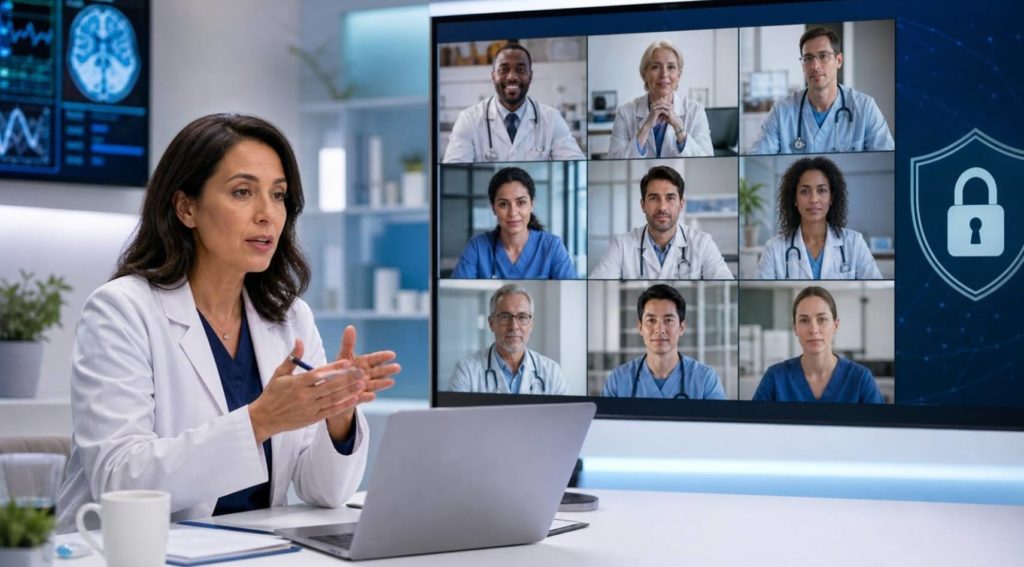
Thus, you need a webinar platform that allows healthcare teams to control access, protect patient confidential data, manage recordings, and create a safer environment for physicians, healthcare professionals, patients, and trainees.
In this guide, we will look at the top secure webinar platforms and their security features, as well as understand why security is important for medical education and telehealth.
What is medical education?
Medical education is a formal training program in which doctors, nurses, medical students, pharmacists, therapists, physicians, and other medical professionals learn about medical knowledge and best practices in healthcare. The goal of medical education is to produce doctors who are sensitive to the health needs of their patients and provide them with quality care. It also aims to equip practitioners to understand disease, promote well-being, and adapt to evolving medical knowledge and healthcare systems.
What is telehealth?
Telehealth is a way to provide healthcare services to patients remotely through a video conferencing platform. It allows doctors and healthcare professionals to consult with patients, discuss symptoms, prescribe treatment & medications, and provide follow-up care without requiring an in-person visit. Telehealth is best for people who live in remote areas or have difficulty leaving their homes for medical treatment.
Why Security Matters in Medical Education and Telehealth
Medical education and telehealth often involve sensitive information, including patient personal details, medical history, medical records, medical images, test results, and discussions about health concerns, symptoms of disease, & possible treatment options. If this information falls into the wrong hands, it could pose a privacy risk, and there is a high chance that the information will be shared publicly.
When you use a secure webinar and video conferencing platform, it helps protect the sensitive information through security features such as encryption, passwords, user authentication, access controls, and secure data storage. These security features are especially useful for medical education because it discusses real patient cases or clinical images.
Security is equally important for creating a safe medical environment during webinars. For example, a doctor may want to discuss a patient’s case with other specialists. If the webinar platform has strong security controls, doctors, medical educators, and patients can communicate freely without unnecessary concerns about privacy.
Telehealth is a virtual appointment in which direct communication takes place between a health professional and a patient, which may discuss the patient’s symptoms, medical history, diagnosis, medication, and treatment plan. A secure webinar platform not only allows healthcare organizations to conduct online education and telehealth more securely but also allows them to control who participates in sessions, share screens, and restrict access to sensitive content.
5 Secure Webinar Platforms for Medical Education and Telehealth
1. Airmeet
Airmeet is the premier webinar platform for medical education that transforms your healthcare events into dynamic, secure, and engaging experiences. This platform is ISO 27001:2022 certified and SOC 2 Type 2 attested. Airmeet uses robust encryption, privacy for sensitive data, VAPT, WSS protocols, GDPR standards, etc.
Airmeet offers an intuitive interface, making it easy for healthcare professionals and patients to use the platform. This platform offers numerous features and capabilities to make your medical education highly effective and successful, such as customizable event space, live HD video streaming, screen sharing, virtual booth, Q&A & polling, networking, and analytics & reporting.
Airmeet supports security features such as data encryption and access control, which protect attendee personal data, medical information, and protected health information (PHI) from unauthorized people, reducing the risk of data leaks.
Airmeet has 4.6 stars on G2 and 4.4 stars on Capterra.
Pros
- Strong security with SOC 2 Type 2 and ISO 27001 certification
- Support various healthcare use cases like CME programs, medical conferences, and healthcare training
- Allow healthcare organizations to create a branded event environment
Cons
- Unable to support telehealth for patient consultation
2. Zoom
Zoom is a webinar platform that is used across the globe. Healthcare organizations of all sizes can use the Zoom platform to better the lives of their patients through several applications such as telehealth, collaborative healthcare, medical education, and population-based care. Zoom enables clinicians and other healthcare professionals to provide high-quality treatment & care, engage with patients, and meet the dynamic needs of their company.
For telehealth, Zoom provides Epic integration that doctors can use to launch video visit appointments. Patients can access Zoom through their MyChart Patient login on a personal computer or mobile device. For structured medical training, Zoom offers features like live Q&A, chat, polls, screen sharing, breakout rooms, and more to make learning sessions more interactive and engaging.
Zoom has 4.5 stars on G2 and 4.6 stars on Capterra.
Pros
- Support large-scale medical education and staff training sessions
- Offer strong security such as encryption, authentication, access controls, waiting rooms, and administrator controls
- Extremely useful for CME programs
Cons
- It is not a complete platform for telehealth
3. Webex Webinars
Webex Webinars allows healthcare organizations to host medical education such as advanced learning lectures and professional development sessions. This platform offers interactive features such as a virtual whiteboard, Q&A, chat, polls, and breakout rooms to make your session highly interactive and engaging.
For telehealth, the platform uses Webex Instant Connect to seamlessly integrate with electronic health records (EHR) systems, allowing you to provide patients with timely diagnosis and treatment information. You can schedule virtual appointments, teleconsultations, and more with just one click—no app installation or an additional login is required for it. You can streamline telehealth workflows with automated patient identification and reduce wait times and delays between treatments with on-demand video consultations for urgent treatments.
Webex is a HIPAA/BAA-compliant webinar platform that uses strong passwords to prevent unwanted access and features a privacy control to manage attendee data and information.
Webex Webinar has 4.6 stars on G2 and 4.4 stars on Capterra.
Pros
- Offers enterprise security and compliance capabilities
- Supports large-scale medical education sessions
- Supports real-time translation, helping medical organizations deliver educational sessions to international audiences
Cons
- A platform that does not have an intuitive interface
4. GoTo Webinar
GoTo Webinar is an all-in-one, AI-powered healthcare communication platform that features secure, high-definition video conferencing, ideal for telehealth appointments. This platform integrates directly with popular EHR systems to simplify and streamline workflows for patient management.
GoTo Webinar has built-in encryption, audit trails, and access controls that protect PHI and support your HIPAA compliance. Along with telehealth, the platform also supports medical education such as live training sessions, expert presentations, and more. For example, a medical school or healthcare organization can use GoTo Webinar to conduct a clinical training session, present a case study, interact with learners through Q&A, and record the session for later learning.
GoTo Webinar has 4.2 stars on G2 and 4.5 stars on Capterra.
Pros
- EHR integrations—connect with healthcare systems such as Epic, Oracle Health, and Athena Health,
- Easy event setup—no technical skills required for setting and managing the event
- Strong security control such as encryption, secure logins, strong event passwords, access control, and more
Cons
- Advanced features may require buying higher-tier plans
5. RingCentral Events
RingCentral Events is a webinar platform that brings staff and patients together with AI-powered team messaging, video conferencing, phone calls, and a modern contact center. You can host telehealth visits with HIPAA-secure video consultations and automated clinical documentation. With the help of the AI Receptionist (AIR), you can schedule appointments 24/7, answer patient questions, and answer urgent patient calls, ensuring that no call goes unanswered.
RingCentral gives your patients a secure and reliable way to connect with your team via phone, text, email, or over 20 digital channels. In addition to this, this platform integrates essential EHR system apps like Epic, Cerner, Allscripts, Medtech, Nextgen, Athenahealth, and eClinicalWorks, helping your healthcare teams connect and communicate with existing patient-care workflows.
RingCentral is HIPAA-compliant and secures communications with enterprise-grade encryption, 99.999% availability, and global compliance certifications like HITRUST, SOC 2, and GDPR. These rigorous security standards protect sensitive patient and member records during phone calls, chat, and video communications.
RingCentral Events has 4.5 stars on G2 and 4.5 stars on Capterra.
Pros
- Support mult-session healthcare conferences
- Offer a detailed analytics dashboard to track your staff engagement, like question asked, poll responses, and more
- Offer breakout rooms, allowing you to separate learners in a group to discuss a clinical case, review a treatment plan, or solve a diagnosis-related problem
Cons
- Need to purchase higher-tier plans to access advanced features
Final Thoughts
Medical education and telehealth often involve sensitive patient information, clinical discussions, medical images, and other confidential data. To prevent unauthorized access and leaks of this data, you must use a webinar platform equipped with robust security and privacy safeguards. Secure webinar software keeps healthcare data out of the wrong hands.
Webinar platforms covered here—Airmeet, Zoom, Webex Webinars, GoTo Webinar, and RingCentral Events—offer strong security features such as data encryption, strong passwords (multi-factor authentication (MFA), single sign-on (SSO), role-based access, waiting rooms, secure storage for recording, and more, making medical education webinars and telehealth secure, safe, and better equipped to protect sensitive healthcare information.
FAQs
Yes, healthcare professionals may share X-rays, MRIs, CT scans, and other medical images during webinars if there is a legitimate educational or medical purpose. When sharing medical images, healthcare providers should remove patient names, addresses, email IDs, phone numbers, and other details that could identify the patient.
Yes, healthcare providers can record medical education sessions and telehealth visits, but they must protect patient information in those recordings.
For example, telehealth includes a patient’s name, medical history, diagnosis, or treatment details. This information is considered protected health information (PHI). Therefore, store them securely and only allow access to the recordings to authorized staff members.
For medical education, healthcare providers should also exercise caution when displaying patient medical reports, including X-rays, MRIs, CT scans, or other medical data. Patients’ names and other identifying details should be removed. Simply put, healthcare providers should ensure that patient information is not unnecessarily disclosed or accessed by unauthorized individuals.