




This blog will teach you how to buy a domain name, what domain registration is, where to get a domain name, and more.
What Is a Domain Name and Why Is It So Important?
Before understanding how to get a domain name, you should first grasp what a domain name is. Your website’s address on the internet is known as its domain name. Just as your home has a physical address so that people can find it, your website requires a domain name to be found online. For example-
These are all examples of domain names.
Every domain name has an IP address. This IP address is a long string of numbers and computers uses it to communicate with each other. However, IP addresses are difficult for humans to remember. Hence, domain names were created as a simpler & more readable option. So, now instead of entering the IP address i.e. 172.217.16.206, you can directly type google.com.
Let’s understand what happens when you type a domain name-
- You enter a domain name in your browser.
- Your browser queries the Domain Name System (DNS) to determine where this domain is situated.
- DNS looks up the IP address associated with the domain.
- The browser connects to the server with that IP address.
- The server transmits the website data back to the browser.
All of this takes milliseconds, which is why websites load so quickly.
Let us now discuss why your domain name is so crucial. Your domain name is important for a number of reasons, including-
- First impressions: This is often the first thing consumers notice about your brand.
- Brand identity: A good domain instills trust and confidence.
- SEO benefits: Search engines use domain relevance as a ranking factor.
- Marketing: A short & straightforward domain is easier to promote.
- Professionalism: Custom domains look more professional than free subdomains.
For example, Airmeet has a simple & memorable domain name that reflects its brand. This helps users remember, search and trust the platform.
What Is Domain Registration?

Domain registration is the official process of claiming a unique domain on the internet & ensuring that no one else can use it. When you register a domain, you are essentially renting it for a specific period, usually one year, with the option to renew it every year.
When you register a domain name, it is added to a global database controlled by the Internet Corporation for Assigned Names and Numbers (ICANN). ICANN ensures that each domain name is unique and appropriately given, ensuring that the internet runs smoothly for all users.
When you register a domain name, a few things happen behind the scenes-
- Your domain name will be reserved solely for you.
- Your ownership information is recorded in the WHOIS database.
- Nobody else can buy, or use that domain while it’s registered to you.
- You get complete control over how the domain is utilized.
However, it is important to remember that domain registration does not guarantee permanent ownership. You are renting the domain for a set time. After that, you must renew it to continue using it.
Many newcomers believe that once they purchase a domain name, it will belong to them forever. This is not correct. If you forget to renew your domain, it will ultimately expire and become available for others to claim and register.
You do not register domains directly through ICANN. Instead, you utilize a domain registrar, which is a corporation approved by ICANN to sell & maintain domain names. These registrars serve as intermediaries between you & the worldwide domain system.
Popular registrars offer features that make domain registration simple, even for beginners. They also provide DNS management, domain forwarding, email setup, and WHOIS privacy protection.
In simple words, domain registration serves as the legal foundation for your internet presence. Without it, you can’t create a significant website, brand or business on the internet.
Types of a Domain Name
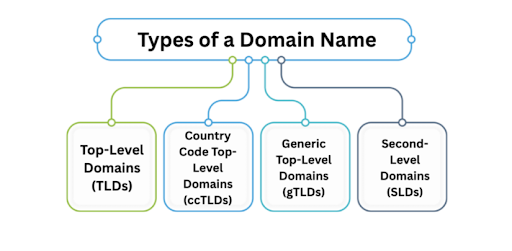
Not all domain names are identical. Domain names are classified into various categories based on their structure and function. Understanding these types will assist you in selecting the appropriate domain for your website and long-term goals.
1. Top-Level Domains (TLDs)
TLDs are the extensions found at the end of a domain name. These are the most apparent aspects of a domain, and play a significant influence in branding & trust. Some examples of frequent TLDs are-
- .com
- .net
- .org
- .info
The ‘.com’ domain is the most extensively used & trustworthy TLD. It is frequently the first pick for corporations, blogs, and startups since users automatically trust ‘.com’ websites. Other top-level domains (TLDs) such as .net, and .org are also popular, particularly among technology businesses and nonprofit groups.
2. Country Code Top-Level Domains (ccTLDs)
Country code top-level domains are extensions that correspond to certain countries or regions. Examples include-
- .us (United States).
- .uk (United Kingdom).
- .in (India).
- .ca (Canada).
These domains are excellent for firms who want to reach a certain country, or audience. For example, a business that only operates in the United States may select a ‘.us’ domain to indicate local importance.
3. Generic Top-Level Domains (gTLDs)
gTLDs include newer extensions that are unrelated to a country. These are typically industry-specific or descriptive. Some examples include-
- .tech
- .store
- .blog
- .events
- .ai
These domains enable organizations to be more imaginative and detailed in their branding. For example, an event platform or webinar company may pick the ‘.events’ domain to explicitly indicate its objective. However, while gTLDs can be valuable, they may not always be as trusted as ‘.com’ domains, particularly among non-technical users.
4. Second-Level Domains (SLDs)
The second-level domain is the principal name of your website, which comes before the extension. For example, airmeet.com’s second-level domain is “airmeet”.
This is the most significant aspect of your domain name because it represents your brand, company or identity. Choosing the appropriate second-level domain necessitates careful consideration because it impacts-
- Brand recognition.
- SEO relevance.
- Marketing success.
How to Choose a Domain Name
Choosing a domain name is more than just selecting something that sounds appealing. It’s a decision that will have long-term implications for your brand, trust, marketing, and even search visibility. Many newbies rush through this phase and eventually regret it. That is why it is critical to take a step back and learn how to properly select a domain name.
A good domain name should be memorable, easy to type, and relevant to your website’s content. When someone hears your domain name for the first time, they should be able to remember it quickly and enter it accurately without any errors or misunderstanding.
Here are some tips on how you can choose a worthy domain name-
1. Keep Your Domain Name Short and Simple
Short domain names are always preferred over long ones. Short domain names are easier to remember, discuss verbally, and enter accurately.
For example, the domain ‘airmeet.com’ is straightforward, clean, and memorable. On the other hand, a long domain with a lot of words can confuse users and diminish confidence. Long domain names often-
- Get mistyped.
- Look unprofessional.
- Are difficult to market.
If feasible, try to keep your domain name under 15 characters.
2. Make Sure the Domain Is Easy to Spell and Pronounce
Your domain name should sound exactly as it appears when written. This is especially vital if you intend to market your website through word of mouth, podcasts, videos, or live events.
Avoid-
- Complicated spellings.
- Slang terms.
- Unusual letter pairings.
If people have to ask, “How do you spell that?” then the domain name is not appropriate.
3. Choose the Right Domain Extension (TLD)
The domain extension, also known as a top-level domain (TLD), has a significant impact on how visitors perceive your website. The most common & reliable extension is ‘.com’. Most consumers intuitively trust and remember ‘.com’ domains over others.
Other frequent extensions are-
- .net (often used for technology or tools).
- .org is often used by organizations.
- .co (popular among startups).
- .io or.ai (used by tech and SaaS businesses).
- Industry-specific TLDs such as.events,.tech, or.digital.
If possible, always try to obtain the .com version first. If it is not available, use an alternative that still appears professional and relevant.
4. Think About Long-Term Growth
Many people select a domain name that is overly specific or restricting. This can pose problems in the future as the website expands or changes direction.
For example, if you select a domain name that concentrates on a specific product, it may not be suitable for expanding into new services. Select a domain name that-
- Can expand alongside your brand.
- Is versatile for future expansion.
- Still makes sense years later.
Where to Buy a Domain Name
Once you’ve decided on a domain name, the following step is to decide where to purchase it. You cannot purchase a domain directly from ICANN. Instead, you buy it from a domain registrar.
A domain registrar is an organization that is allowed to sell and maintain domain names. Not every registrar is the same. A good registrar should provide-
- Clear and transparent pricing.
- Easy-to-use dashboard.
- Reliable customer service.
- Free or inexpensive WHOIS privacy.
- Strong security features.
For beginners, simplicity and support are very important.
Some of the most well-known domain registrars are-
Each registrar offers unique benefits. Some are better for newcomers, while others are better for experienced users or businesses.
Here are some other options-
1. Buying a Domain Name from Hosting Providers
Many hosting firms also provide domain registration. This is sometimes a fantastic choice for newbies who want everything in one location. Benefits of purchasing a domain from a hosting company-
- Easier website setup.
- A single account for domain and hosting.
- Domain is free for the first year (in many circumstances).
- Simplified DNS configuration.
This option is very useful if you’re creating your first website and want to minimize technical processes.
2. Buying a Domain Name Directly vs Domain Resellers
Some sites resell domains rather than being primary registrars. While this may be convenient, it is critical to understand who actually owns your domain. When deciding where to purchase a domain name-
- Ensure that the domain may be transferred easily.
- Ensure that you have full ownership rights.
- Avoid sites with hidden costs and limits.
For most newcomers, purchasing a domain name and hosting package is the simplest option as it avoids confusion and allows you to get online faster. However, sophisticated users may opt to retain their name & hosting separate for greater flexibility.
Common Domain Registration Mistakes to Avoid
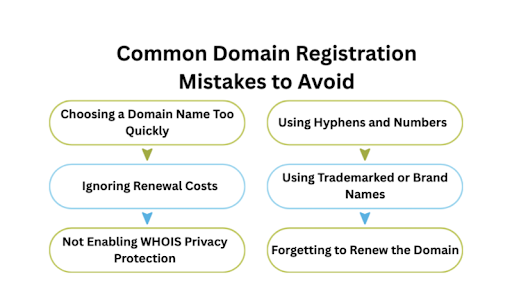
Many people make minor mistakes during domain registration that eventually lead to major issues. Recognizing these blunders early on can save you time, money and stress.
1. Choosing a Domain Name Too Quickly
One of the most common blunders is hurrying the choice. A domain name isn’t something you should alter frequently. Allow time to brainstorm, study, and test ideas. Ask yourself-
- Will this name still make sense after five years?
- Is it easy to understand and remember?
- Does it align with my brand vision?
2. Ignoring Renewal Costs
Some registrants offer extremely low first-year pricing but charge substantially higher renewal fees. Always check-
- Renewal Price.
- Auto-renewal settings.
- Grace period policies.
A cheap domain name may become expensive in the long run.
3. Not Enabling WHOIS Privacy Protection
Skipping WHOIS privacy is a frequent beginner mistake. Without privacy protection, your personal information becomes public knowledge. This could lead to-
- Spam emails.
- Scam phone calls.
- Misuse of identities.
WHOIS privacy is a minor expenditure that provides substantial protection.
4. Using Hyphens and Numbers
Domains containing hyphens, or numerals are more difficult to remember and often appear less trustworthy. For example-
- best-event-platform-2024.com (not optimal).
People may forget where the hyphen is or mistake numbers with words.
5. Using Trademarked or Brand Names
Registering a domain with someone else’s brand or trademark can result in legal complications, and forced domain loss. Always ensure that your domain name is unique and legally safe.
6. Forgetting to Renew the Domain
Failure to renew your domain may result in-
- Website downtime.
- Email service failure.
- Domain being purchased by someone else.
Always enable auto-renewal and keep your payment information updated.
Conclusion
Learning how to get a domain name is an essential step in your online adventure. It may appear confusing at first, but if you understand the fundamentals, it becomes quite straightforward.
A domain name is more than just an internet address. It represents your brand, identity and long-term digital assets. Take the time to choose properly, register with a reputable registrar, protect your privacy, and renew on time.
Successful platforms and companies, including Airmeet, make an effort to select domain names that are clear, professional & scalable. This enables them to grow, market effectively and gain trust from their target audience.
A domain name may appear to be a little detail, but it has a huge impact on how people view your website, and how easy it is to find & remember it.
FAQs
Domain registration normally takes only a few minutes once payment is received. Once registered, the domain becomes active almost instantly, while DNS modifications may take a few hours to spread globally. Most people can start using their domain name on the same day.
No. You cannot purchase a domain name permanently. Domain names are registered for a limited duration, often one year, and must be renewed on a regular basis. To ensure uninterrupted ownership, you can register a name for numerous years in advance & enable auto-renewal.
To check domain name availability, visit the domain registrar’s website & use the domain search tool. Enter your preferred name, and the system will immediately assess whether it is available. If not, it will suggest other domain names or top-level domains.