

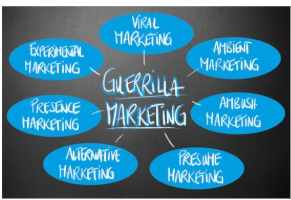

Guerilla marketing often takes place in public places like shopping malls, airports, and subways to surprise the audience and create a memorable brand experience for them. This frequently leads to viral marketing, in which the news about such a campaign spreads rapidly from one person to another.
In this article, we will discuss guerrilla marketing in depth, covering real-life examples and case studies.
What are the Different Types of Guerrilla Marketing?
1. Indoor Guerrilla Marketing
Indoor guerrilla marketing involves surprising and capturing the audience’s attention in spaces such as shopping malls, metros, and subways. The purpose of this tactic is to surprise audiences in indoor environments, generate strong brand recall, and encourage word-of-mouth marketing.
A famous example of indoor guerrilla marketing is when IKEA turned a Paris metro station into a fully furnished lounge with sofas and lamps.
2. Experiential Guerrilla Marketing
Experiential guerrilla marketing focuses on designing immersive experiences for target audiences and engaging them directly with the brand. It occurs through pop-up stores and interactive installations, fostering a deeper connection with customers, creating an amazing experience and lasting memory.
A famous example of experiential guerrilla marketing is Lipton’s campaign, which encouraged people to press a button to cool down in the hot sun, as the installation released a refreshing spray of water mist.
3. Outdoor guerrilla marketing
Outdoor guerrilla marketing is an unconventional, low-cost strategy that involves setting up appealing displays in public places to capture the attention of passers-by. This strategy usually works best in urban environments where there is a lot of foot traffic.
A famous example of outdoor guerrilla marketing is the “Folgers Coffee Manhole” Covers in New York City, where the steam coming from the sewers was made to resemble a cup of hot, fresh coffee.
Why is Guerrilla Marketing Still Vital for Businesses in 2026?
Guerrilla marketing creates an unexpected twist and adds a sense of surprise that not only draws the audience’s attention but also encourages them to share it with others. Now, in the age of social media, the chances of this marketing strategy going viral are so much higher.
In fact, studies reveal that guerrilla marketing campaigns can increase brand awareness by up to 70%, generate 5 times more word-of-mouth marketing, are 6 times more likely to be shared on social media, increase social media engagement by up to 1000%, and result in a 30% increase in sales.
Guerrilla marketing not only brings in an element of surprise and creativity, but also creates memorable experiences and a strong emotional connection with audiences. Therefore, Guerrilla marketing continues to be one of the most powerful marketing strategies in 2026 and beyond.
What are the Pros and Cons of Guerrilla Marketing?
Pros | Cons |
Guerilla marketing helps your brand reach a massive audience without needing a huge advertising budget | If the message you are trying to convey through this campaign is not clear, people may find the stunt confusing |
This marketing campaign is more likely to be shared on social media by the audience, ensuring maximum exposure | There is no real guarantee that a guerrilla marketing campaign will go viral |
A guerrilla marketing campaign may grab the attention of media outlets, reaching new markets through news coverage | These initiatives are often “one-hit wonders.” Once the surprise wears off, the impact doesn’t last long, but rather fades away. |
Through this marketing approach, you are able to connect with your target audience on an emotional level, creating a unique impression on them about your brand | |
You can set up your marketing “stunt” in a location where your audience hangs out frequently, such as a shopping mall or a popular park. | |
These initiatives require a smaller budget compared to traditional and online advertising |
7 Real-Life Examples of Guerrilla Marketing
1) Burger King – The Moldy Whopper
Burger King launched the “Moldy Whopper” campaign in 2020, featuring a 35-day time-lapse video ad in which a Whopper burger slowly decays, with green and white mold growing all over it. The brand wanted to show that its Whopper now has zero artificial preservatives across several markets.
Burger King saw a 14% increase in sales after the launch of this campaign. The campaign received over 8.4 billion impressions. Plus, they won 18 Gold Pencils at The One Show 2020.
2) Dominos: Paving for Pizza
This was one of Domino’s creative marketing initiatives designed to address a relevant problem: the pizza getting damaged during delivery, due to potholes and bad roads.
The delivery was not happening as expected. The pizzas were not arriving fresh to customers — sometimes the cheese would stick to the top of the box, and other times the toppings would scatter all over the box. To solve this issue, Domino’s offered funds to small towns in America to repair potholes and damaged roads.
3) Coca-Cola’s ‘Hug Me Machine’
Coca-Cola launched a creative marketing campaign called “Hug Me Machine”, which turned an ordinary vending machine into an engaging, emotional experience. The campaign, which took place in Singapore, aimed to get people to hug the machine and get a free can of Coke.
This campaign received 116+ million media impressions and 1.5 million views within its first hour. Further, it received over 33 million views on Weibo within a week and was aired on numerous US television channels such as ABC, CBS, CNN, and NBC.
Coca-Cola not only created a memorable experience for its audience but also created an emotional connection with them through this campaign.
4) UNICEF’s Dirty Water Vending Machine
UNICEF installed vending machines in New York City to raise awareness about the world’s lack of clean drinking water. The vending machines contained bottles with dirty water – each labeled with diseases caused by unsafe water, such as malaria, cholera, and typhoid.
The purpose of the campaign was not to sell dirty water, but to bring about real awareness around the dangers of unsafe drinking water and encourage donations to support clean water.
5) KFC Crocs
This is a guerrilla marketing strategy that was carried out by a collaboration between two iconic brands, KFC and Crocs. The idea behind “KFC Crocs” was to create a limited-edition pair of clogs that visually resembled a bucket of fried chicken.
When they released the limited-edition KFC Crocs in 2020, consumers showed intense interest, with many of these Crocs selling out within minutes on the website.
The campaign was trending on platforms like X (Twitter) and Instagram at the time. It also received coverage from major media outlets like CNN and the BBC.
6) Google Pixel Fold 3D Billboard Campaign
It was one of the great examples of sneaky advertising campaigns that made use of 3D illusion technology to demonstrate the unique design and folded display of the “Google Pixel foldable smartphone”.
The campaign ran on large digital screens in New York’s famous Times Square and other major city locations. People began filming it and sharing it on social media.
In New York alone, this installation, captured on 25 digital screens, got an unparalleled reach, reaching over 60 million potential customers
7) McDonald’s: The Fries Crosswalk
McDonald’s ran a creative campaign in which they painted pedestrian crossing lines in the shape of French fries in Switzerland in 2010. Here, the attention of every pedestrian on the street was skillfully captured.
Pictures of the special crosswalks spread widely across social media. The campaign made sure that its goal of increasing brand awareness was successfully achieved.
Final Thoughts
Guerrilla marketing is a bold marketing tactic that brings unparalleled brand exposure to the company. It not only generates tremendous buzz but also attracts the audience in an unconventional manner.
Guerrilla marketing adds wonder, curiosity, and originality to the marketing campaign, creating impactful branding moments in real-time, which create a lasting memory that no marketing tactic can replicate.
Guerrilla marketing, in fact, is an amazing marketing strategy for businesses that are trying to differentiate their brand in a crowded marketplace.
FAQs
- Define your campaign objective, such as brand awareness, promoting new products, or driving traffic to your website
- Know your target audience – their age group, their interests, their hangout locations, etc.
- Set your advertising budget – identify the materials required, production costs, team size, etc
- Think outside the box and create unusual and surprising campaigns, execute the campaign as planned, and make sure to create a buzz
- Leverage social media platforms like Instagram, Facebook, and YouTube to support your guerrilla marketing initiatives
- Monitor the results of your campaign by tracking the foot traffic, social media engagement, sales generated, etc
Yes, small brands can launch a guerrilla marketing campaign without needing a huge budget. Small businesses can set up a surprise “pop-up” event in a local park or display creative posters of their product in a crowded area to grab people’s attention and raise brand awareness.
Consider the following factors to assess the success of your guerrilla campaign:
- Check whether your campaign is covered by media partners
- See if people share it on their social media accounts
- See if your campaign is mentioned in local news
- Check if influencers put it on their Instagram stories
- See if pop-up booths attract a high volume of traffic