




For SaaS companies especially, brand consistency matters. Your product is your brand. Your marketing is your brand. Your webinars should be your brand too. Every touchpoint shapes how prospects perceive your company—and webinars represent some of your highest-value interactions with potential customers.
This guide explains
- Why do branded webinar experiences matter for SaaS companies?
- What customization capabilities should you demand from your platform?
- How can you create fully branded events that strengthen rather than dilute your market position?
Why Webinar Branding Matters More for SaaS Than Other Industries
SaaS companies face unique challenges that make branded webinars particularly important.
1. Trust Is Your Currency
According to research, 59% of people say that they need to trust a brand before they’ll even think about making a purchase. In SaaS, where customers commit to ongoing subscriptions and often integrate your software deeply into their operations—trust matters even more.
Every branded touchpoint reinforces that trust. When your webinar looks professional, polished, and completely aligned with your website, product, and other marketing materials, you signal competence and attention to detail.
2. You’re Selling an Intangible Product – A Software
Physical products can be held, touched, and examined. SaaS products are intangible. Prospects can’t see or touch your software until they sign up for a trial or demo. It makes your brand presence even more important—and it is often the most tangible thing prospects can evaluate.
A fully branded webinar experience gives prospects something concrete to connect with. It demonstrates what working with your company feels like. If your webinar feels polished and professional, the prospects will assume that your product is too.
3. Competition Is Intense and Differentiation Is Hard
The SaaS market is crowded. Multiple vendors often offer similar features at comparable price points. When functional differences are minimal, brand perception becomes a primary differentiator.
Generic webinar experiences make you look like everyone else. Fully branded experiences set you apart and also reinforce your unique positioning. It is especially crucial for the smaller SaaS companies that are competing against the larger and more established players.
4. Long Sales Cycles Mean Multiple Touchpoints
B2B SaaS sales cycles often span months—and they involve numerous stakeholder interactions. Before making a decision, the prospect might
- Attend three webinars.
- Read five blog posts.
- Watch two product videos.
- Have four sales conversations.
Consistent branding across all these touchpoints creates a cohesive narrative.
5. Product-Led Growth Requires Brand Alignment
Several SaaS companies embrace product-led growth strategies where the product itself drives acquisition as well as expansion. In this model, every interaction with your brand should feel like an extension of the product experience.
For instance
When prospects attend a webinar which looks nothing like your product interface or the website—you create cognitive dissonance. They’re learning about your solution in an environment that feels disconnected from it.
With branded webinars that mirror your product’s look & feel, you can create a more unified and also persuasive experience.
What “Fully Branded” Really Means for Webinar Platforms
Many platforms claim to offer branding customization capabilities—however, the reality often falls short. Here’s what truly comprehensive branding capabilities should include.
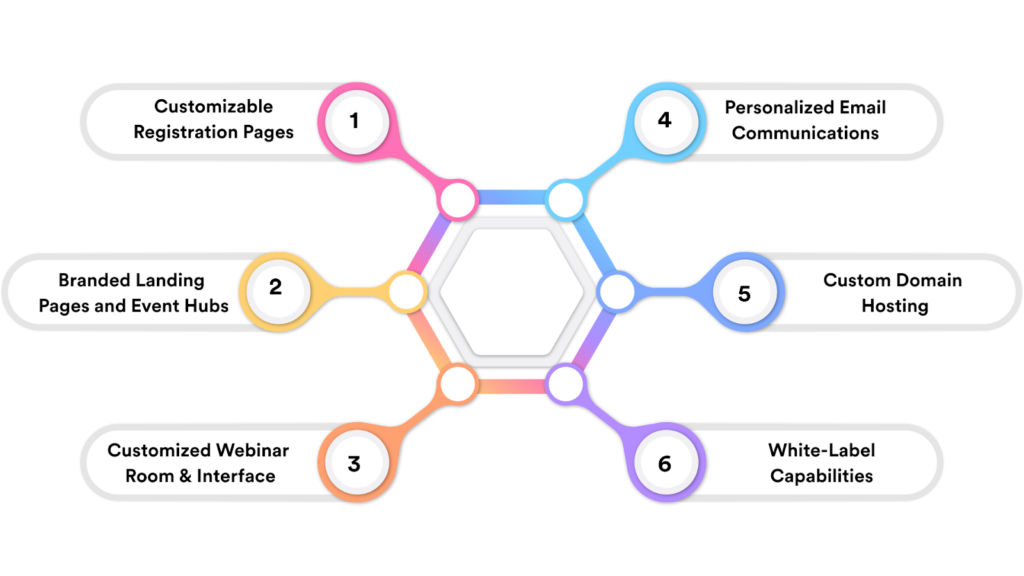
1. Customizable Registration Pages
Your registration page is the first impression of your webinar. It should look like a native part of your website—not a third-party form.
Key capabilities
- Complete control over layout and design.
- Ability to add your logo, colors, and fonts.
- Custom background images or videos.
- Flexible form fields that match your data collection needs.
- Customizable button text and styling.
- Ability to add custom CSS for advanced design control.
The best registration experiences feel completely native to your site. Prospects shouldn’t be able to tell they’re interacting with third-party webinar software.
2. Branded Landing Pages and Event Hubs
Beyond the individual registration pages, several SaaS companies run multiple webinars—and they need cohesive event hubs or series pages.
Key capabilities
- Create custom landing page templates that reflect your brand.
- Organize multiple webinars under a unified visual theme.
- Embed event calendars that match your site design.
- Maintain consistent navigation and user experience—across all webinar pages.
Capabilities like Airmeet’s AirStudio allow you to fully personalize the event interface and assets and also communications for brand consistency across all touchpoints. It ensures every interaction with your webinar program reinforces your brand identity.
3. Customized Webinar Room and Interface
This is where many platforms fall short. The actual webinar room, where attendees spend most of their time, often reveals the underlying platform.
Key capabilities
- Customizable stage backgrounds with your branding.
- Ability to add your logo to the interface.
- Control over button colors, fonts, and styling.
- Branded waiting rooms that attendees see before the event starts.
- Custom layouts that reflect your design language.
- Option to hide all third-party platform branding.
Generic webinar rooms with standard layouts and default colors undermine your brand. The room should feel like a natural extension of your website and product.
4. Personalized Email Communications
Email touches represent a huge portion of the webinar experience. From registration confirmations to reminders to follow-ups, every message shapes perception.
Key capabilities
- Send emails from your domain—not the platform’s.
- Complete control over email templates and design.
- Ability to match your standard email marketing style.
- Custom sender names that align with your team structure.
- Branded email signatures and footers.
For example
If attendees receive emails from “[email protected]” with generic templates, you’re actively damaging brand consistency. All communications should look like they came directly from your company.
5. Custom Domain Hosting
The most sophisticated branding option is hosting your entire webinar experience on your own domain or subdomain.
Instead of sending prospects to “genericplatform.com/yourevent,” they visit “webinars.yourcompany.com” or “events.yourcompany.com.” The entire experience lives on your infrastructure (from a prospect’s perspective), eliminating any visible connection to the underlying platform.
Key capabilities
- Branded domain & URLs.
- White-labeling & brand consistency controls.
- SSL/HTTPS Support.
- Custom email domain.
- Custom landing & registration page hosting.
- Seamless embedding & integration.
- Custom subdomains.
- SSO & Authentication on the custom domain.
- Compliance and governance controls.
Custom domain hosting provides
- Complete brand ownership.
- Eliminates any platform branding from URLs.
- Improves SEO value from webinar pages.
- Creates a more professional, enterprise-grade impression.
Such customization capabilities are usually offered in the higher-tier plans or enterprise agreements. However, for those SaaS companies who are serious about brand consistency—it is worth the investment.
6. White-Label Capabilities for Advanced Use Cases
Some SaaS companies, especially large enterprises or event agencies which are serving multiple clients, require true white-label capabilities.
Key capabilities
- Complete removal of any platform branding, anywhere in the system.
- Ability to customize every visual element.
- API access to build custom integrations as well as workflows.
- Option to resell or embed the platform as the part of your own offering.
White-label solutions give you complete control, but typically require significant investment and also technical resources to implement them properly.
Key Branding Features That SaaS Companies Need
Beyond the basics, certain branding capabilities deliver particularly high value for SaaS businesses.
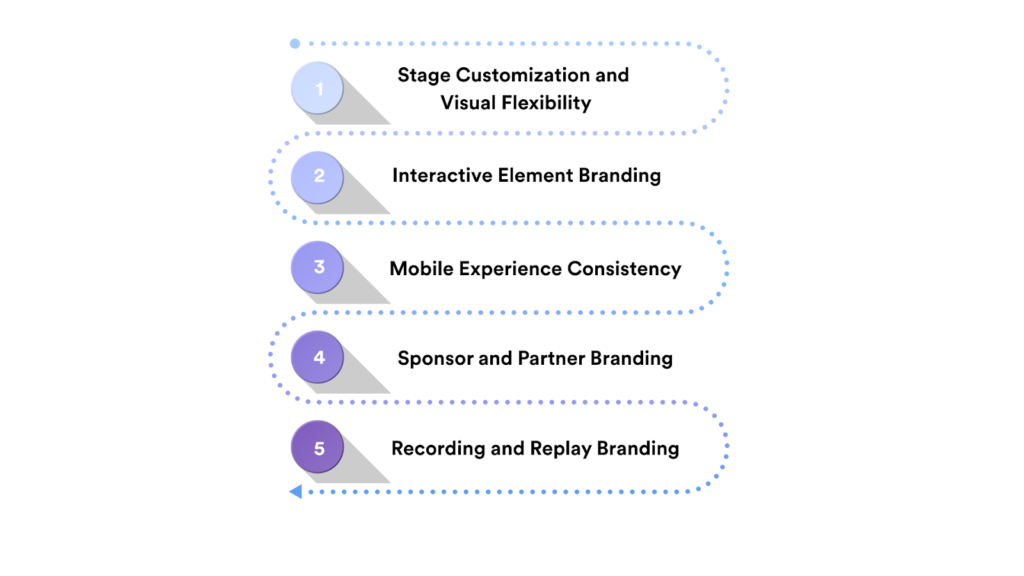
1. Stage Customization and Visual Flexibility
Your webinar stage is your digital storefront during events. You need complete control over how it looks.
Key features
- Multiple layout options—centered presenter, side-by-side with slides, and panel formats.
- Custom backgrounds for showcasing your brand or product.
- Ability to share custom video intros & the outros.
- Green screen capabilities for advanced production.
- Flexible positioning of presenter video relative to the content.
2. Interactive Element Branding
Polls, Q&A, CTAs, and other interactive features should match your brand design language.
Key features
- Custom button colors and styling for CTAs.
- Branded poll templates.
- Consistent fonts and colors in Q&A displays.
- Ability to style chat interfaces and emoji reactions.
When every element of your webinar looks cohesive, attendees stay immersed in your brand experience. When polls pop up in a generic style, it breaks that immersion and also distracts them.
3. Mobile Experience Consistency
Many attendees join webinars from mobile devices. Your branding needs to translate smoothly—across screen sizes.
Key features
- Responsive design that maintains brand identity on small screens.
- Mobile apps that can be customized with your branding.
- Consistent color schemes and logos across all devices.
- Optimized layouts that still feel branded on phones and tablets.
Test your branded webinar experience on multiple devices for ensuring consistency.
4. Sponsor and Partner Branding
Many SaaS companies run co-marketing webinars or sponsored events. You need to accommodate multiple brands gracefully.
Key features
- Ability to display multiple logos (yours as well as partners).
- Customizable sponsor sections or virtual booths.
- Flexible layouts that can give appropriate prominence to each of the brands.
- Reporting that shows brand visibility as well as engagement of sponsors.
Co-marketing webinars help generate valuable leads. However, they do require sophisticated branding controls for representing all the parties appropriately.
5. Recording and Replay Branding
Your webinar’s value extends far beyond the live event. Recordings become content assets that prospects discover months later.
Replay branding essentials
- Branded video players that match your site design.
- Custom thumbnails featuring your branding.
- Ability to add your logo to recorded video.
- Consistent visual experience between live and on-demand viewing.
Generic replay pages with platform branding waste the long-term content value of your webinars. On-demand viewers should see the same professional, branded experience as live attendees.
With webinar platforms like Airmeet, you can maximize reach with RTMP in/out and multistreaming capabilities. It enables you to
- Stream into Airmeet from tools like OBS/VMix straight onto the stage.
- Stream out to YouTube, Facebook, or custom RTMP endpoints for broader audience capture.
All this while maintaining your brand presence—across the channels.
Evaluating Platforms Based on Branding Capabilities
When choosing a webinar platform for your SaaS company, assess branding capabilities systematically.
1. Branding Flexibility Assessment
Start with basic questions about what you can customize.
Critical elements you should look for
- Can I customize all registration pages completely?
- Are webinar room colors, fonts, and layouts flexible?
- Can I use my own domain for all webinar experiences?
- Do emails come from my domain with my templates?
- Can I remove all platform branding everywhere?
- How much CSS or design control do I have?
If a platform limits customization in any critical area, that’s a dealbreaker for SaaS companies serious about branding.
2. Template Quality and Starting Points
Even with full customization, having good templates helps to accelerate your branding efforts.
Critical elements you should look for
- Professional-looking default templates you can build from.
- A variety of layout options for different event types.
- Templates that reflect modern design standards.
- Mobile-responsive templates that can work—across the devices.
Starting with quality templates saves significant time compared to building everything from scratch, even if you ultimately customize heavily.
3. Ease of Branding Implementation
Some platforms offer extensive branding options but make them difficult to implement.
Critical elements you should look for
- Can non-technical marketers apply branding or does it require developers?
- How long does it take to create a fully branded event?
- Can you save brand templates for reuse across events?
- Is there a learning curve for branding tools?
The best platforms put branding power in the marketers’ hands—without requiring ongoing technical resources.
4. Brand Consistency Across Event Types
Your platform should support consistent branding regardless of the webinar format.
Critical elements you should look for
- Do live & automated webinars share branding options?
- Can series or recurring events maintain visual consistency?
- Does branding extend to hybrid events and is it incorporated with in-person elements?
- Are virtual booths & networking spaces brandable?
Fragmenting your brand across different event types creates confusion and looks unprofessional.
5. Integration with Existing Brand Assets
Your webinar platform should work with your established brand infrastructure.
Critical elements you should look for
- Can you import brand assets from your CMS or DAM?
- Does it integrate with your design systems or component libraries?
- Can you apply your existing CSS stylesheets?
- Does it support your approved fonts and also the color systems?
Platforms that integrate with your existing brand asset management help in reducing duplication and also ensure consistency.
Platform Requirements for SaaS Companies
Different platforms serve different needs. In this section, we will examine how we can match platform’s capabilities with the specific requirements.
For Early-Stage SaaS Companies
If you’re pre-Series A or running lean, you need affordable branding without huge complexity.
Key platform criteria
- Intuitive branding tools that don’t require developers.
- Affordable pricing that works at your scale.
- Good default templates you can customize.
- Essential branding touchpoints are covered (pages, emails, and rooms).
- Quick implementation that doesn’t delay launches.
For Growth-Stage SaaS Companies
As you scale, you need more sophisticated branding capabilities as well as consistency.
Key platform criteria
- Extensive customization options across all touchpoints.
- Template systems for maintaining consistency at scale.
- Good integration with your martech stack.
- Support for multiple brands or product lines.
- Advanced features—like custom domains and white labeling.
For Enterprise SaaS Companies
Large SaaS businesses need enterprise-grade branding capabilities & governance.
Key platform criteria
- True white-label capabilities if needed.
- API access for custom integrations.
- Multi-org support for different business units.
- Advanced security and compliance.
- Sophisticated branding governance tools.
- Dedicated support for implementation & for optimization.
For SaaS Companies Running Agency Models
If you are managing webinars for multiple clients or brands—you need multi-tenant capabilities.
Key platform criteria
- Ability to manage multiple distinct brand identities.
- Sub-account structures for client separation.
- Efficient brand switching without recreating assets.
- Client-specific reporting and analytics.
- Potential white-label reselling options.
How Branded Webinars Impact Key SaaS Metrics
Investing in branded webinar capabilities isn’t just about aesthetics. It affects real business outcomes.
1. Conversion Rate Impact
Prospects are more likely to convert when they experience consistent branding—throughout their buyer journey.
Impact
- Professional appearance helps in building trust & credibility.
- Consistent messaging helps in reinforcing the key value propositions.
- Reduced friction as the prospects don’t need to mentally switch the contexts.
- Stronger brand recall when decision time comes.
2. Registration and Attendance Improvements
Branded registration pages that match your site design usually outperform the generic forms.
Impact
- Prospects trust familiar designs more than foreign-looking forms.
- Reduce abandonment as the experience feels native.
- Have higher perceived value, when webinars look professional.
- Have better mobile conversion with the responsive branded designs.
3. Brand Recall and Awareness
Every branded interaction reinforces your company’s presence in prospects’ minds.
Impact
- Consistent visual identity—across the touchpoints—helps in improving recall.
- Professional appearance helps in elevating the brand perception.
- Unique design elements become memorable brand signatures.
- Repeated exposure to your branding—leveraging email, pages, and also events helps build familiarity.
4. Customer Retention and Expansion
Branded webinars aren’t just for prospects. They’re powerful tools for initiatives like customer education and onboarding as well as community building.
Impact
- Professional training webinars demonstrate ongoing investment in customer success.
- Consistent branding helps in reinforcing the customers’ decision to choose your product.
- Community webinars strengthen belonging and also loyalty.
- Branded educational content becomes a differentiating retention asset.
5. Competitive Differentiation
In feature-parity markets, brand becomes a primary differentiator.
Impact
- Polished webinar experiences signal quality as well as professionalism.
- Unique visual approaches help the prospects remember you specifically.
- Consistent branding makes your company appear more established & stable.
Common Branding Mistakes SaaS Companies Make
Even with good platforms, execution mistakes undermine branded webinar experiences.
1. Inconsistent Brand Application
The most common mistake is applying branding inconsistently—across different webinar elements.
Solution
- Create comprehensive brand guidelines.
- Document approved colors, fonts, logo usage & email templates as well as visual examples.
2. Over-Branding That Distracts
Some companies go too far, creating branded experiences that overwhelm the content. Like extremely large logos, distracting backgrounds, etc.
Solution
Use branding strategically. Strong in registration and waiting areas but more subtle during the active content delivery.
3. Ignoring Mobile Experience
Inconsistent mobile experience negatively impacts the viewers who’ve joined via mobile phones. It includes irregular logo size, colors that look different on phone screens, broken layouts, etc.
Solution
Test every branded element on multiple mobile devices and ensure that your branding scales appropriately as well as remains recognizable at all screen sizes.
4. Neglecting Email Branding
Many SaaS companies focus intensely on webinar page branding but leave emails generic.
Solution
- Apply the same branding rigor to emails as you do to pages & to the webinar rooms.
- Custom templates, proper sender domains, consistent design, and branded signatures should be standard.
5. Platform Branding That Leaks Through
Even with branded elements in place, underlying platform branding sometimes appears, like:
- Default error messages with platform branding.
- URLs that reveal the platform provider.
Solution
Review every possible touchpoint—including error states and edge cases. Work with your platform provider to establish proper process to avoid these instances.
Bottom Line
For SaaS companies, branded webinar experiences aren’t optional or just nice-to-haves. They’re strategic necessities which may directly impact the business outcomes. Generic webinars with third-party branding undermine trust, reduce conversions, and also waste the opportunities to reinforce your market position.
Comprehensive branding means controlling every touchpoint—such as registration pages that match your website, email communications from your domain, webinar rooms with your visual identity as well as consistent experiences across all the devices & contexts. When prospects interact with your webinars, they should never question whether they’re engaging with your brand.
The investment in branded webinar capabilities pays off through higher conversion rates, stronger brand recall, improved competitive differentiation, and better customer retention. Even modest improvements in these metrics more than justify the cost of sophisticated branding tools.
The best platforms make branding powerful yet accessible, putting control in marketers’ hands without requiring constant developer support.
Your webinars represent high-value interactions with prospects and customers. Make sure those interactions reinforce the professional, trustworthy brand you’ve worked hard to build.